Stinging insect infestations in Auburn escalate rapidly between late spring and early autumn, driven by the moist microclimates of the Green River basin and Stuck River Valley. Queen wasps emerge from overwintering…
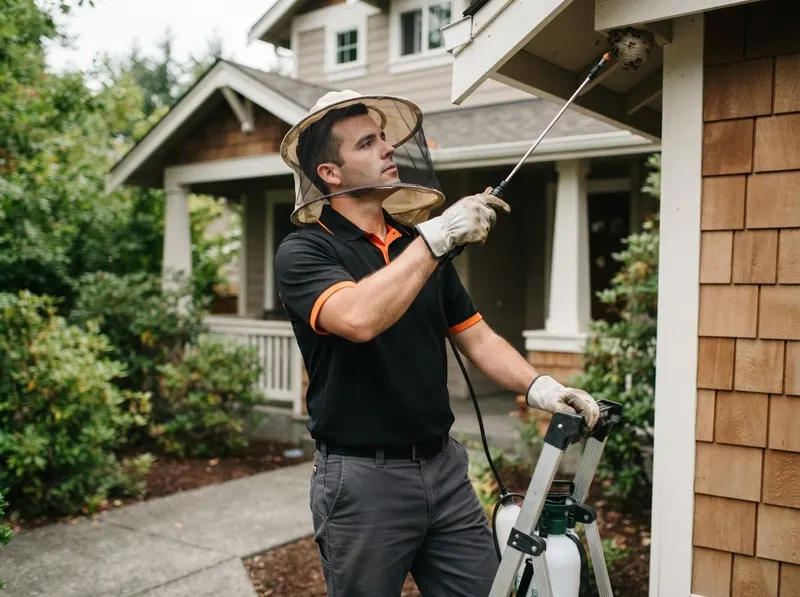
Stinging insect infestations in Auburn escalate rapidly between late spring and early autumn, driven by the moist microclimates of the Green River basin and Stuck River Valley. Queen wasps emerge from overwintering sites in April to construct brood combs beneath the eaves of single-family residences in West Hill, Lea Hill, and Lakeland Hills. Ground-nesting yellowjackets exploit vacated rodent tunnels in landscaped perimeters near Game Farm Wilderness Park Area and the Riverwalk trail network. Left unmanaged, an individual nest can expand to house over 4,000 workers by late August, creating genuine sting risks for households, children, and domestic pets. Store-bought pyrethroid aerosol canisters frequently trigger defensive swarming behaviors rather than colony collapse because chemical contact rarely reaches the core reproductive queen inside multi-layered paper combs or wall voids.
SilverNest Insect Control implements an integrated pest management approach aligned with EPA Integrated Pest Management standards. Interventions utilize micro-encapsulated pyrethrins derived from chrysanthemum flowers and mineral dusts containing amorphous silica, recognized by the California Department of Pesticide Regulation for low mammalian toxicity. Formulations comply with Washington State Department of Agriculture pesticide rules and are placed strictly into harbourage voids rather than drifted across open yards. Ground colonies are treated using pressurized application rods meeting OSHA personal protective equipment standards, which safely inject targeted powders directly into tunnel systems without saturating topsoil or contaminating nearby municipal storm lines monitored by the Washington State Department of Ecology.
Decision-fit considerations center on structural location versus colony density. Exposed aerial paper wasp nests on a first-story garage fascia require straightforward physical detachment and enzymatic surface neutralization to dissolve pheromone tracking scent. Conversely, structural wall-void yellowjacket nests in North Auburn or the Terminal District demand directional thermal-imaging localization and dust injection via structural weep screeds or exterior siding seams. The primary trade-off is mechanical removal speed versus void penetration depth: treating an interior cavity requires calibrated residual powders to allow worker insects to track active ingredients into the brood comb over 24 to 72 hours, avoiding drywall punctures inside living areas. Every treatment is designed to protect beneficial pollinators documented by the Pollinator Partnership and supported by WSU King County Extension research, strictly avoiding broad-spectrum perimeter drenching near flowering native plants.
To ensure durable deterrence, properties receive preventative barrier treatments along eaves, roof valleys, and window framing. Technicians seal structural gaps larger than 0.25 inches using copper mesh and silicone sealants according to guidelines established by the Pest Control Technology professional trade network and the National Pest Management Association. Outdoor waste containers are evaluated against sanitation metrics outlined by the Public Health Seattle and King County environmental health division to strip forage sources that sustain summer colonies.
Every job gets a firm, written price after a free on-site visit.
For standards, safe disposal, and service guidance on PEST CONTROL SEVICE in Auburn, WA, useful references include U.S. EPA, ENERGY STAR, U.S. Dept. of Energy, Consumer.gov, U.S. Census Bureau, and Google Maps. General consumer and small-business resources are available from USA.gov, Better Business Bureau, FTC Consumer Advice, U.S. Small Business Administration, and Ready.gov.
Tell us about your stinging insect and wasp abatement job in Auburn and we'll send a clear, written quote, usually the same day.
 SilverNest Insect Control